Managing Your Time and Focus
What are you working on today?
Explore the Strategies
Remember: There is no single strategy that works for everyone. Even when strategies work for someone most of the time, no strategy works every single time. Experiment with different approaches, give yourself time to adjust, and keep the strategies that make your academic life more manageable.
1. Time Blindness
“I struggle to estimate how long tasks will take.“
Time blindness refers to difficulty perceiving the passage of time, estimating how long activities will take, or anticipating future deadlines. You might underestimate how long an assignment will take, lose track of time while doing something enjoyable, or suddenly realize a deadline is approaching.
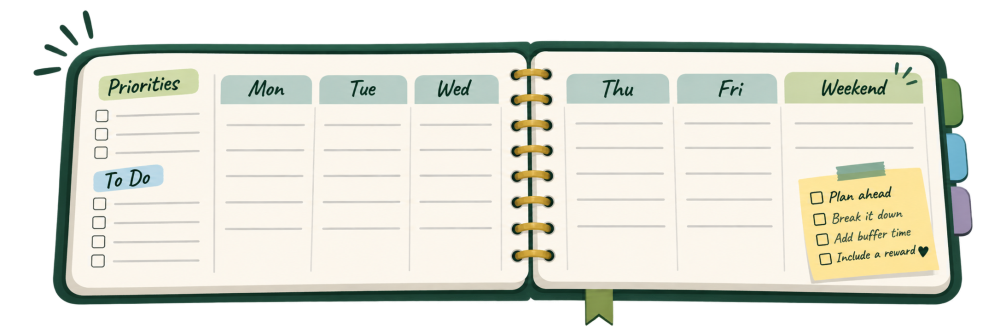
Strategies to Try
MAKE YOUR TIME VISIBLE
- Use a visual timer or countdown clock to see how much time you have left.
- Wear a watch to develop a more concrete awareness of time throughout the day.
- Keep a wall calendar somewhere visible to track assignments, appointments, and deadlines.
- Use alarms and reminders to signal when it’s time to start, stop, or transition between activities.
GET EVERYTHING OUT OF YOUR HEAD
- Write down your plans, even when they seem small or simple.
- Use a planner, calendar, or scheduling app to keep track of responsibilities.
- Break large assignments into smaller tasks with individual deadlines.
- Schedule specific times for studying, completing assignments, and taking breaks.
PLAN BACKWARD
Start with your final deadline and work backward to determine when each step needs to be completed.
For example, if a paper is due Friday, your schedule might look like this:
| Day | Task |
| Monday | Choose a topic and gather sources |
| Tuesday | Complete research and organize notes |
| Wednesday | Write the first draft |
| Thursday | Revise, edit, and proofread |
| Friday | Submit your paper |
Planning backward helps you recognize how much time you actually need rather than waiting until the deadline is close.
BUILD IN BUFFER TIME
Give yourself extra time between activities and before deadlines. If you think something will take 30 minutes, consider scheduling 40–45 minutes. Unexpected interruptions and transitions can take longer than anticipated.
Quick Activity: The Daily Brain Dump
At the beginning of each day, take five minutes to write down everything you need to accomplish. Sort your list into three categories:
- Must Do: Tasks with immediate deadlines or consequences.
- Should Do: Important tasks that can be scheduled.
- Could Do: Smaller tasks that can wait if necessary.
This helps you prioritize without trying to remember everything at once. Having trouble falling asleep? Try the daily brain dump at night right before you go to bed instead.
Need Help With Time Management?
UCAE Academic Consultations can help you map out your semester, prioritize assignments, and develop a realistic schedule.
View scheduling instructions for Academic Consultations.
You can also explore the 25/5 Pomodoro Method.
2. Sustaining Focus & Attention
“I struggle to stay focused on boring, repetitive, or lengthy assignments.”
Maintaining attention can be challenging, especially when a task requires sustained mental effort or doesn’t provide immediate feedback. You might find yourself switching between activities, getting distracted by your surroundings, or struggling to return to an assignment after an interruption.
The goal isn’t to force yourself to concentrate indefinitely. Instead, build a study routine that incorporates movement, variety, and intentional breaks. Attention operates like a muscle. The more you practice, the stronger it gets.

Strategies to Try
MOVE TO FOCUS
Movement can help you feel more alert and break up long periods of sitting.
- Take a 5–10 minute walk before beginning a study session.
- Stretch or do a few simple exercises between assignments.
- Try standing while reviewing notes or listening to a lecture.
- Take movement breaks when you notice your attention beginning to fade.
CHANGE YOUR ENVIRONMENT
Sometimes a change of scenery can help you reset your attention.
- Try studying in a different location when you feel stuck.
- Alternate between quiet study spaces and more active environments, depending on the task.
- Keep your workspace relatively free of unnecessary distractions.
- Experiment with background noise, instrumental music, or silence to find what helps you concentrate.
INTRODUCE VISUAL NOVELTY
Our attention is naturally drawn to things that stand out. Introducing variety into your study routine can make tasks feel less repetitive.
- Use colorful sticky notes, highlighters, and visual checklists.
- Turn lengthy notes into diagrams, mind maps, or visual summaries.
- Alternate between reading, writing, reviewing, and practicing.
- Change your study location or workspace setup occasionally.
CAPTURE DISTRACTING THOUGHTS
Sometimes unrelated thoughts appear right when you’re trying to concentrate.
- Keep a piece of paper nearby to write down unrelated thoughts and reminders.
- If you remember something you need to do, add it to your to-do list instead of stopping your current task.
- Close unnecessary browser tabs and silence notifications.
- Use website blockers if you find yourself repeatedly checking distracting websites.
Try These Focus Resets
Move to Focus: Take a short walk, stretch, or move around before beginning a work session. Use movement to help transition into a focused state.
Move to Motivate: If you’re struggling to get started, try an energizing activity. Put on an upbeat song, take a quick walk, or do something that helps you build momentum.
Move to Reset: If you feel mentally exhausted or overwhelmed, step away from your assignment for 5–10 minutes. Give yourself time to recharge before returning.
Find Your Study Space
- Reserve a quiet individual study room at Atkins Library.
- Visit the UCAE in Colvard 2200 and use the Learning Commons as a study space. Our hours are 8 AM–7 PM Monday–Thursday and 8 AM–5 PM Friday.
3. Working Memory & Learning
“I forget things even when I know they’re important.”
Working memory is the ability to temporarily hold and use information. It helps you follow instructions, remember what you just read, and keep track of multiple steps while completing a task.
You might understand something during a lecture but struggle to recall it later, forget instructions halfway through an assignment, or lose your train of thought while reading.

Strategies to Try
WRITE IT DOWN IMMEDIATELY
- When you remember something important, record it in your planner, notes app, or to-do list.
- Keep a running list of questions, reminders, and tasks.
- Don’t rely on remembering something later. If it matters, write it down now.
- Use checklists for assignments that involve multiple steps.
READ ACTIVELY
Instead of passively reading through a chapter, engage with the material.
- Keep a pen in your hand while reading.
- Underline important information and write questions in the margins.
- Pause after each section and summarize what you just read.
- Write down unrelated thoughts so they don’t interrupt your reading.
- Turn headings into questions and look for their answers as you read.
USE VISUAL LEARNING TOOLS
Visual representations can help you organize and connect information.
- Create concept maps to show how different ideas relate.
- Use diagrams to break down complicated processes.
- Highlight or color-code related concepts.
- Connect new information to examples or concepts you already understand.
REDUCE COGNITIVE OVERLOAD
Trying to remember too many things at once can make tasks more difficult.
- Break instructions into individual steps.
- Focus on one part of an assignment at a time.
- Keep relevant materials in front of you.
- Refer to written instructions instead of relying on memory.
- Limit unnecessary distractions when learning new information.
Quick Activity: The Three-Point Reading Check
After completing a reading section, write down:
- What was the main idea?
- What are three important details?
- What question do I still have?
This encourages active recall and helps you identify information you may need to review.
Make Studying More Active
Try different approaches to reinforce information:
- Flashcards: Practice recalling information instead of simply rereading it.
- Teach Someone Else: Explain a concept in your own words as if you were teaching a classmate.
- Practice Questions: Test your understanding before looking at the answers.
- Concept Mapping: Connect related concepts visually.
- Spaced Review: Revisit information over several days rather than studying everything at once.
4. Organization & Digital Clutter
“I struggle to keep track of my notes, assignments, files, and browser tabs.”
Organization involves more than keeping a tidy desk. Digital files, browser tabs, class notes, and assignment materials can quickly become overwhelming.
Creating consistent systems makes it easier to find what you need and reduces the mental effort involved in keeping track of everything.

ORGANIZING YOUR BROWSER TABS
Too many open tabs can make it difficult to find information and stay focused.
- Close Unnecessary Tabs: If you aren’t actively using a tab, close it or save it for later.
- Bookmark Frequently Used Pages: Save websites, course materials, and resources you regularly visit.
- Group Your Tabs: Organize tabs by class, assignment, or project.
- Use a Reading List: Save articles and websites you want to revisit without keeping them open indefinitely.
ORGANIZING DIGITAL FILES
Create one central location for your academic materials.
- Choose One Main Storage Location: Google Drive and Microsoft OneDrive are useful options for storing and accessing files.
- Create Folders: Organize files by semester, class, or assignment.
- Use Consistent File Names: Name documents so you can easily identify them later.
- Organize as You Go: Put new files in the appropriate folder as soon as you download or create them.
- Delete Unnecessary Copies: Periodically review your files and remove outdated duplicates.
Example Folder Structure:
- Fall 2026
- HIST 3000
- Lecture Notes
- Readings
- Assignments
- ENGL 4000
- Lecture Notes
- Readings
- Assignments
- HIST 3000
ORGANIZING YOUR NOTES
A consistent note-taking system can make studying and reviewing information easier.
Try Different Note-Taking Methods:
- Cornell Notes: Divide your page into sections for notes, key questions, and a summary.
- Outlining: Organize information using headings, subheadings, and bullet points.
- Concept Mapping: Use diagrams to show relationships between ideas.
- Digital Notes: Use an app or document system that allows you to organize and search your notes.
Build a Consistent System
- Try using the same general note-taking approach for each class.
- Store your notes somewhere you’ll naturally remember to look.
- Label notes with the course name and date.
- Review your notes every few days rather than waiting until an exam.
- Keep a separate list of questions or concepts you need to revisit.
Quick Activity: 10-Minute Digital Reset
Set a timer for 10 minutes and:
- Close unnecessary browser tabs.
- Move downloaded files into their appropriate folders.
- Rename any documents you can’t easily identify.
- Organize your notes from the day.
- Write down anything you need to follow up on.
Small, regular resets can prevent digital clutter from becoming overwhelming.
5. Motivation & Getting Started
“I know what I need to do, but I can’t seem to start.”
Sometimes the hardest part of an assignment isn’t completing it; it’s getting started.
You might procrastinate even when you understand the importance of a task, feel overwhelmed by where to begin, or find it difficult to stay motivated when there is no immediate reward.
Rather than waiting until you feel motivated, try creating conditions that make starting easier.

Strategies to Try
START SMALLER THAN YOU THINK YOU NEED TO
- Commit to working for just five minutes.
- Open the document and write one sentence.
- Read one page instead of committing to an entire chapter.
- Break large assignments into small, specific actions.
Getting started can make it easier to continue.
USE THE 2-MINUTE RULE
If a task takes less than two minutes, consider completing it immediately rather than adding it to your mental to-do list.
Examples include:
- Replying to a quick email.
- Adding an assignment deadline to your calendar.
- Downloading a reading.
- Putting away materials after studying.
TRY BODY DOUBLING
Body doubling involves working alongside another person to create a sense of structure and accountability.
- Study with a friend.
- Work in a library or shared study space.
- Join a virtual study session.
- Tell someone what you plan to accomplish before starting.
You don’t necessarily need to work on the same assignment. Simply having someone else present can help some students stay on task. The UCAE’s Accountability Groups are perfect for this.
MAKE TASKS MORE ENGAGING
- Listen to instrumental music if it helps you concentrate.
- Use colorful materials or visual checklists.
- Turn repetitive tasks into small challenges.
- Alternate between different types of assignments.
- Set small milestones and reward yourself when you reach them.
CREATE A DOPAMINE MENU
A dopamine menu is a personalized list of enjoyable activities you can turn to when you need a boost in motivation or energy.
Consider organizing your menu into three categories:
- Quick Boosts: Listen to a favorite song, make a snack, or step outside.
- Longer Breaks: Take a walk, call a friend, or watch an episode of a show.
- Recharge Activities: Spend time on a hobby, exercise, or do something relaxing.
Choose activities that help you recharge without making it difficult to return to your work.
Quick Activity: The Five-Minute Start
Choose one assignment you’ve been avoiding.
- Write down the very first action you need to take.
- Set a timer for five minutes.
- Work only on that first step.
- When the timer ends, decide whether you want to continue.
Your goal isn’t to finish the assignment. It’s simply to get started.
6. Emotional Regulation & Impulsivity
“I sometimes react before thinking, become overwhelmed easily, or struggle to transition between activities.”
ADHD can affect self-regulation, including how individuals manage impulses, activity levels, attention, and emotions.
You might find yourself interrupting others, making quick decisions, feeling frustrated when something doesn’t go as planned, or having difficulty calming down after a stressful situation.
Developing strategies to recognize and manage these experiences can help you navigate academic responsibilities and everyday situations.

Strategies to Try
PAUSE BEFORE REACTING
- Give yourself a moment before responding to a frustrating email or conversation.
- Take a few slow breaths before making a decision.
- Write down your thoughts before responding when emotions are running high.
- If possible, step away from a stressful situation and return when you’re ready.
RECOGNIZE YOUR TRIGGERS
Pay attention to situations that tend to cause frustration, impulsive reactions, or emotional overwhelm.
- Notice whether certain environments make it harder to regulate your emotions.
- Identify tasks or situations that consistently cause stress.
- Recognize when hunger, fatigue, or overstimulation may be affecting how you feel.
- Think about which strategies have helped you manage similar situations in the past.
BUILD IN TRANSITION TIME
Switching between activities can be difficult, especially when you’re deeply engaged in something.
- Set reminders before you need to transition to another activity.
- Give yourself a few minutes to finish what you’re doing.
- Write down where you left off so you can return to the task later.
- Use a short routine to signal that it’s time to move on.
MANAGE OVERWHELM
When everything feels urgent, it can be difficult to determine what to do first.
- Take a short break away from your current environment.
- Write down everything that’s on your mind.
- Identify one task you can realistically complete right now.
- Break larger responsibilities into smaller steps.
- Ask for help.
PRACTICE SELF-COMPASSION
- Recognize that struggling with a task doesn’t mean you’re lazy or incapable.
- Focus on what you can change rather than criticizing yourself.
- Acknowledge small accomplishments.
- Give yourself permission to adjust a strategy that isn’t working.
Quick Activity: Pause, Identify, Respond
When you feel overwhelmed or notice an impulsive reaction developing, try this three-step approach:
- Pause: Stop for a moment before reacting.
- Identify: Recognize what you’re feeling and what may have triggered it.
- Respond: Decide what action would be most helpful in the situation.
The goal isn’t to eliminate emotions or impulses. It’s to create a little more space between what you experience and how you respond.
Find Your Support System
You don’t have to navigate academic challenges on your own. The University Center for Academic Excellence (UCAE) offers resources and support to help you develop strategies for academic success.
Academic Consultations
Work with a UCAE staff member to develop time-management strategies, organize your semester, and build effective academic routines.
View Academic Consultation scheduling instructions.
Learning Commons
Visit the UCAE in Colvard 2300 to find a space to work and study.
Additional ADHD Toolkit Resources
Explore the other resources in the ADHD Toolkit for additional strategies, study techniques, and practical tools.
Image Sources:
https://www.planetspark.in/communication-skills/intrapersonal-communication-skills
https://sparkl.me/blog/ap/grinnell-mstering-ap-exams-within-an-individually-advised-curriculum/
https://mindtastik.com/focus-deep-work/study-meditation-for-students