Overcoming Mental Blocks
Feeling stuck? Let’s find a way forward.
You might be telling yourself you are just procrastinating, or worse, that you are lazy. Neither is true. Procrastination is not a lack of care or effort—it is a traffic jam in your executive functioning. Instead of trying to brute-force your way through “procrastination,” get behind the label to pinpoint what is actually stalling you out. Then you can skip the guilt and go straight to a strategy that works for your brain.
What’s getting in your way?



01 | Getting Started: Also known as Task Initiation
“I know what I need to do, but I can’t seem to start.“

Make starting easier:
| Small Scale Strategies | Large Scale Strategies |
| The 5-Minute Rule: Commit to working on your assignment for exactly 5 minutes. If you want to stop after 5 minutes, you have permission to stop. (Most of the time breaking the initial friction is enough to help you keep going) | Daily To-Do List: At the beginning of each day, identify your three most important priorities. Write them down somewhere visible and check them off as you make progress. (A shorter, realistic list helps you focus on what matters without getting overwhelmed by everything you need to do) |
| Chunk It Down: Break your assignment into smaller, manageable tasks that take only 5-10 minutes each. Instead of writing an entire paper, start by opening your document, reviewing your notes or writing one paragraph. (Smaller tasks feel less overwhelming and make it easier to build momentum) | Visualize Success: Take a moment to picture what it will feel like to finish your assignment. Think about the relief of submitting it, having one less thing to worry about, and being able to move on to something else. Make your visualization as detailed as possible. (Connecting a task to a positive feeling of completing it can help make getting started feel more worthwhile) |
Turn One Big Task into Smaller Steps:
Example: Take a big task like completing a research paper and break it down into very small steps. Those are the steps you put on a to-do list.
- Open a new document.
- Read the assignment prompt.
- Choose a topic
- Find one useful source.
- Write your first rough sentence.
Want someone to sit and focus with?
Try UCAE Accountability Groups.
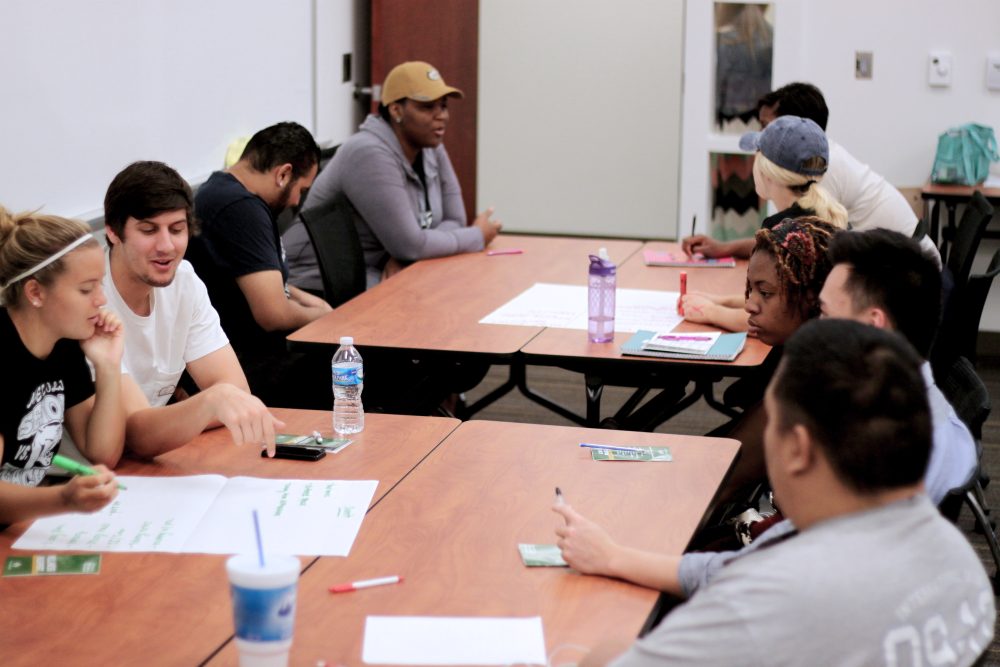
Capitalize on the productivity strategy known as “body doubleing” and work alongside other students in a structured, supportive 75-minute session. Sometimes it is easier to get started when you are working with someone who is also working, even when you aren’t working on the same thing. Set a goal, work on your assignments, and check in on your progress.
View the Accountability Group schedule online and join one today! →
A NOTE ON PROCRASTINATION: Sometimes procrastination isn’t about avoiding the assignment itself; it’s about avoiding the discomfort of getting started. When a task feels too big or you don’t know where to begin, putting it off can feel easier than facing it. Instead of waiting until you feel motivated, give yourself permission to start small. You don’t have to finish the assignment today. You just have to take the first step.
02 | Feeling Overwhelmed & Perfectionism Blocks
“A massive project is making me freeze up.“

First, identify where the feeling of overwhelm is coming from.
This will help you identify what kinds of solutions will help you break through the block.
Technology
Too many apps, tabs, and documents.
Instructions
Too many directions to process.
Choices
Too many possible ways to begin.
Notes
Too much information to organize.
Tangents
Getting sidetracked by interesting,
but unrelated information.
Perfectionism
Fears of imperfection or failure.
Your information overload reset
Before continuing, take a moment to simplify your assignment.
- Identify the main assignment requirements.
- Choose only the resources you need.
- Set a time limit for research and planning.
- Write unrelated thoughts in a separate list.
- Return to your original goal.
From overwhelming to manageable
The B-Minus Draft: You can edit a messy page, but you can’t edit a blank one.
BEFORE
Write a perfect paper
Research everything. Find the perfect argument. Write the perfect introduction.
AFTER
Start a rough draft
Write three ideas. Add one source. Create a messy first paragraph. If the first paragraph is feeling sticky, start with the third paragraph. If word choice and sentence structure are sticky, write fragments and bullet points.
Make the task a game
Introduce a little novelty and challenge to make starting more engaging.
Beat the clock!
Find three sources in 15 minutes.
Level up!
Complete one small milestone at a time.
Reward progress
Celebrate each completed step.
A NOTE ON PROCRASTINATION: Procrastination often goes hand in hand with feeling overwhelmed or wanting everything to be perfect. You might put off an assignment because you don’t know where to begin, feel like you need to do more research, or worry that your work won’t meet your expectations. Remember that preparation has its limits. At some point, you have to let yourself move from planning to doing. A rough draft, an imperfect first attempt, or even a few scattered ideas are all progress.

Need help breaking down a big assignment?
Schedule an Academic Consultation ->
Bring your assignment prompt or rubric to a UCAE Academic Consultation. Work with a staff member to identify requirements, organize your ideas, and develop a realistic plan.
Image sources:
https://www.snhu.edu/about-us/newsroom/education/student-stress
https://www.invoiceonline.com/the-entrepreneur-s-handbook/finance-and-accounting/invoicing/how-to-create-an-accurate-hourly-invoice-89245